
Shape · finish · detail
Product Crafts
Explore four groups of perfume bottle processes, from glass forming to coordinated caps and accessories. Bring your design reference and we can discuss a suitable combination for your model.
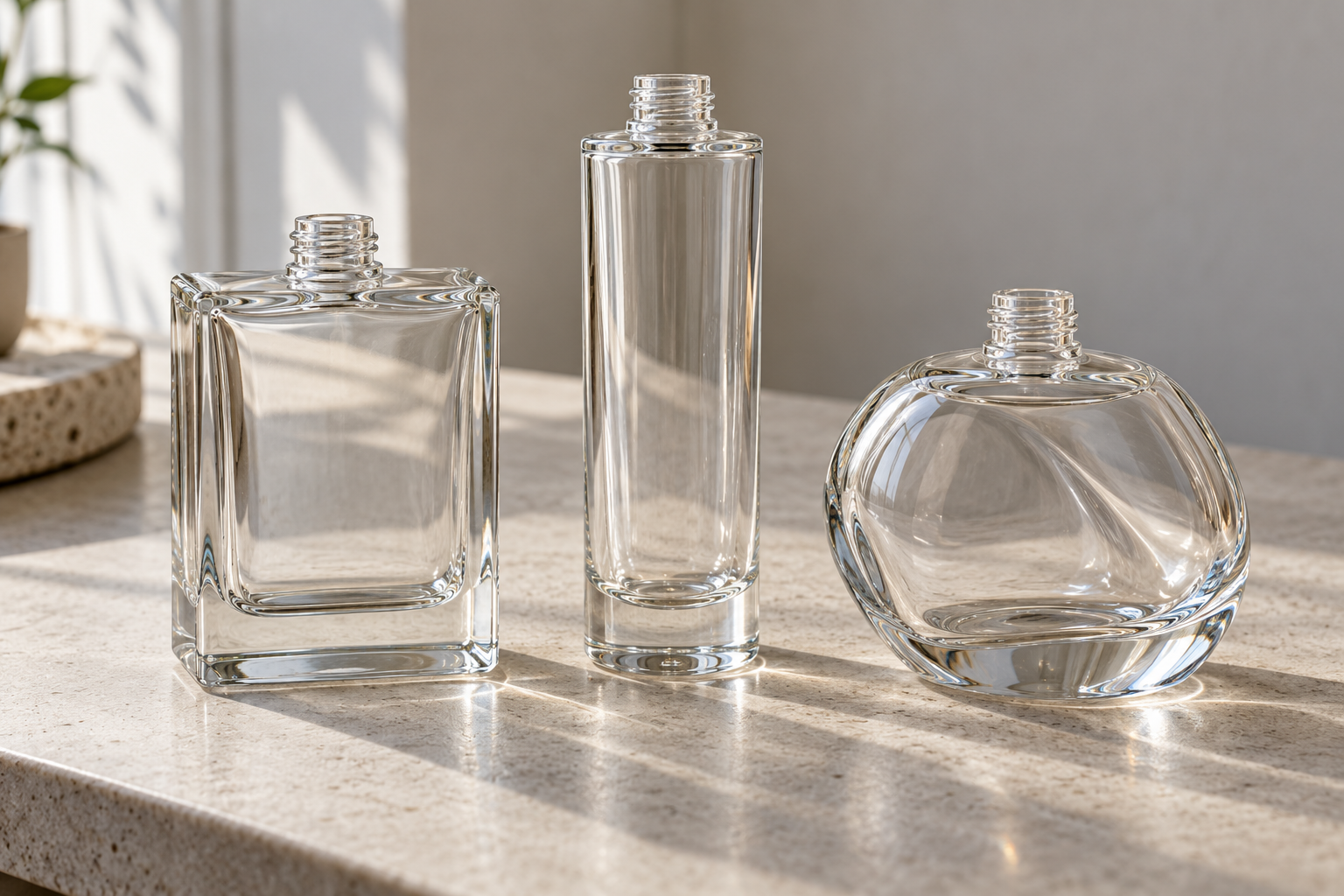
01 · Shape, wall distribution and base profile.
Glass Bottle Forming
Press-blow forming
A plunger presses the initial glass blank, then compressed air forms it in the final mould. Often selected for stable production of bottles with defined profiles and substantial bases; suitability depends on the design.
Blow-blow forming
The glass is blown into a parison and then blown again in the final mould. This route can support slender bottle profiles and narrow-neck designs.
Hand-blown glass
Craft forming for limited editions and artistic designs. Each piece may have small variations; feasibility, tolerances and cost are reviewed for the project.
Annealing & mouth finishing
Controlled cooling reduces internal stress after forming. Fire polishing can smooth mouth edges where specified. Moulded embossing or debossing is designed into the forming mould.
Process availability, tolerances and finish compatibility are confirmed for the exact model. Agree on the finish, dimensional requirements and component compatibility before confirming production.
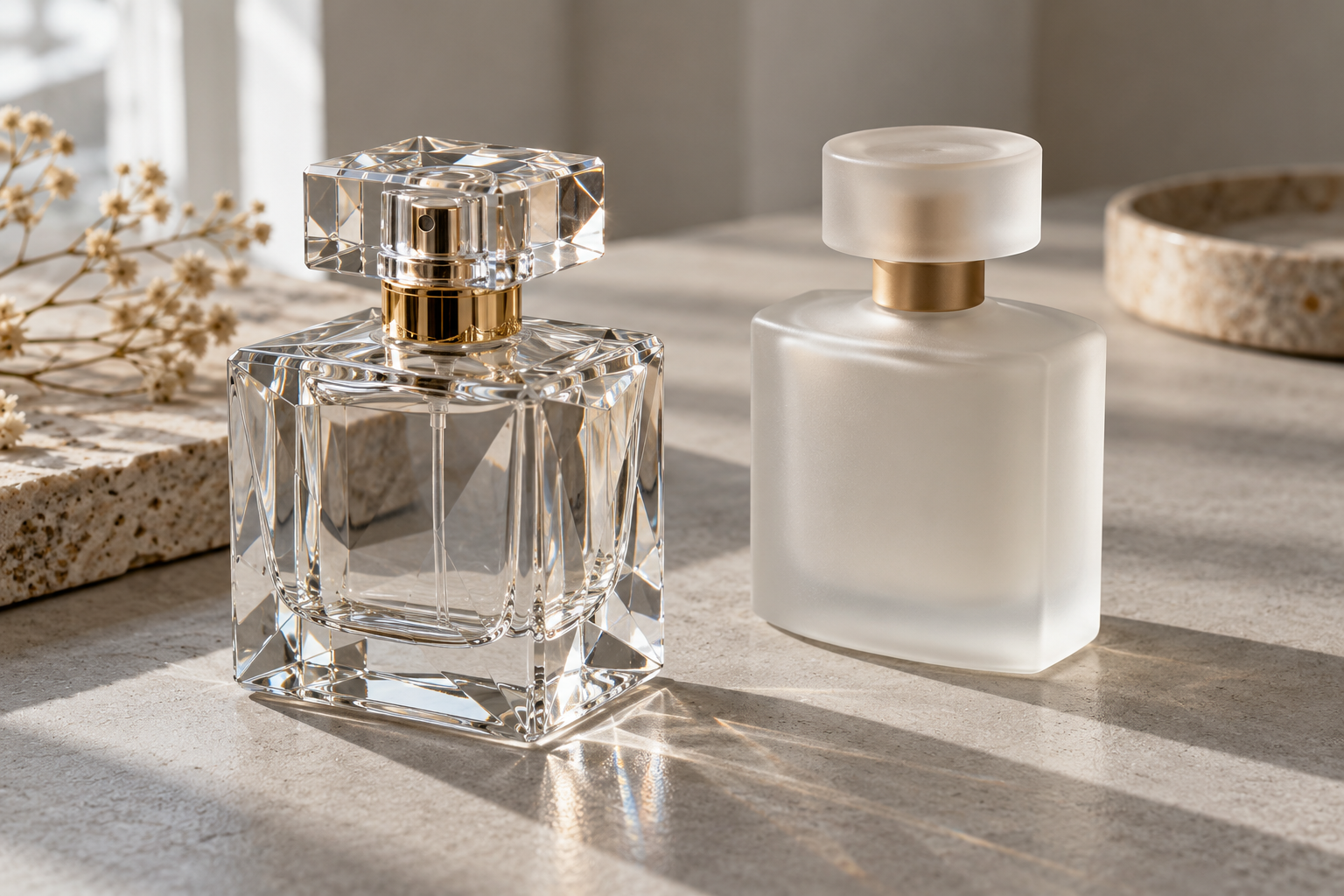
02 · Facets, polishing and precision surface detail.
Cold Processing
CNC grinding & faceting
Precision cutting and grinding create geometric facets and defined edges. Glass formulation, thickness and the design determine the achievable result.
Polishing
Coarse and fine polishing can improve selected surfaces, edges and optical clarity. Internal access and bottle geometry affect which areas can be polished.
Sandblasting
A physical abrasive process creates a matte surface or masked pattern. It differs from chemical acid etching in both process and surface feel.
Laser engraving
Laser marking creates logos or patterns on suitable glass surfaces. Detail, contrast and tactile finish are confirmed against the agreed design and production requirements.
Process availability, tolerances and finish compatibility are confirmed for the exact model. Agree on the finish, dimensional requirements and component compatibility before confirming production.
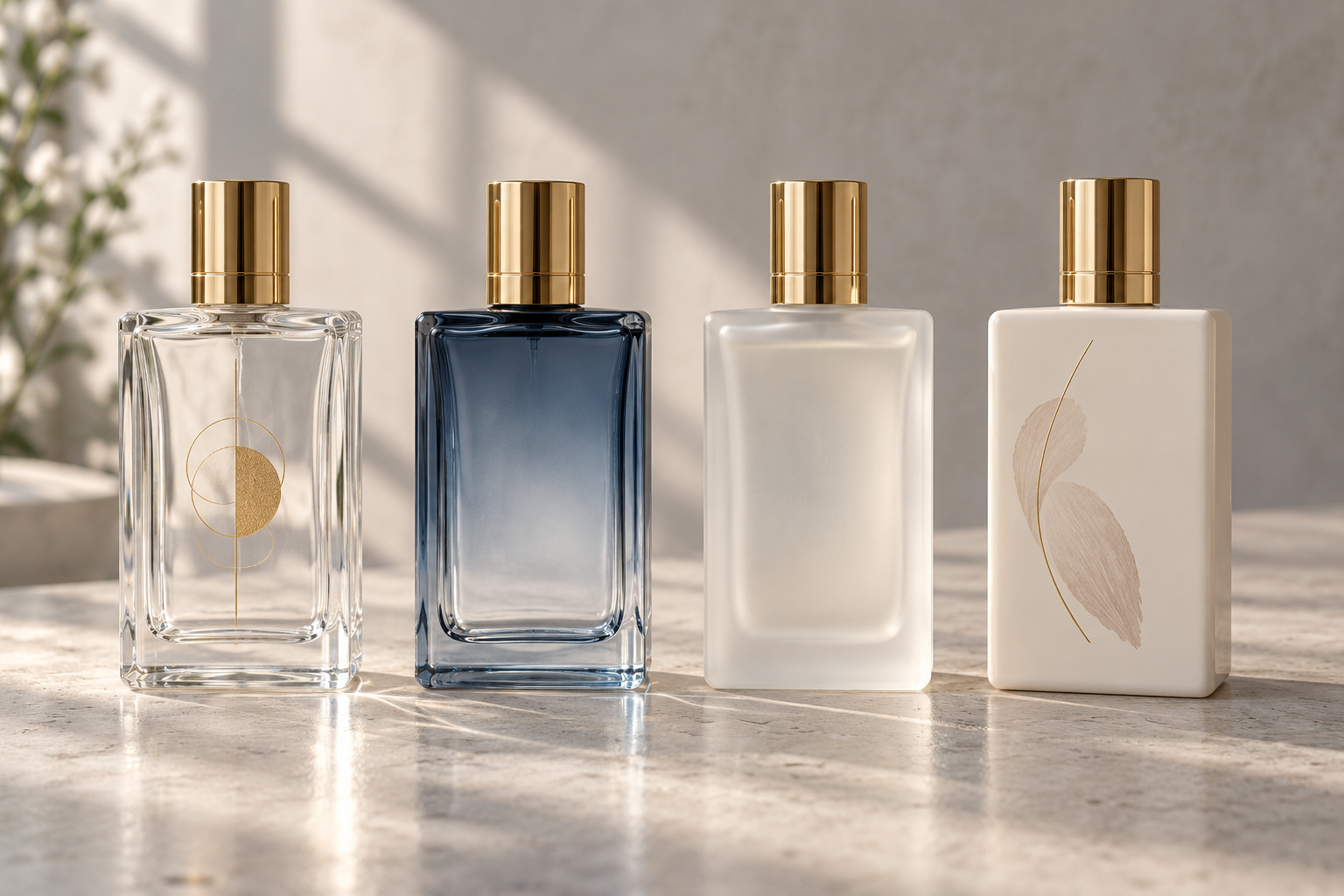
03 · Color, texture and brand graphics.
Surface Decoration
Acid-etched frosting
A chemical etching process creates an even, softly diffused matte appearance. This is distinct from physical sandblasting.
Exterior & interior coatings
Exterior finishes include solid colors, gradients, pearlescent and metallic effects, soft-touch coatings and UV clear finishes. Interior coloring requires a suitable bottle opening, application method and formula-compatibility review.
Screen printing
Screen-applied graphics suit logos and text. Ink systems, color count and curing method are selected for the bottle, finish and durability requirements.
Hot foil stamping
Heat and pressure transfer gold, silver or rose-gold foil to a prepared surface. Artwork size, curvature and coating adhesion are checked before production.
PVD & metal plating
Metallic finishes can be applied to suitable glass, plastic or metal components. The substrate, preparation and chosen coating system determine adhesion and wear performance.
UV digital printing
Digital color graphics can support detailed artwork, gradients and short-run concepts without a traditional print screen. Surface treatment and adhesion are checked for the selected design.
Hydrographic transfer
Transfer films can apply wood-grain, marble or artistic patterns to curved forms. Pattern alignment and the protective finish are confirmed for the selected bottle shape and decoration layout.
Special decorative effects
Crackle coatings, flocking and decorative decals add texture or complex graphics. Embossed and recessed details made directly in the mould are part of bottle forming, rather than an added surface coating.
Process availability, tolerances and finish compatibility are confirmed for the exact model. Agree on the finish, dimensional requirements and component compatibility before confirming production.
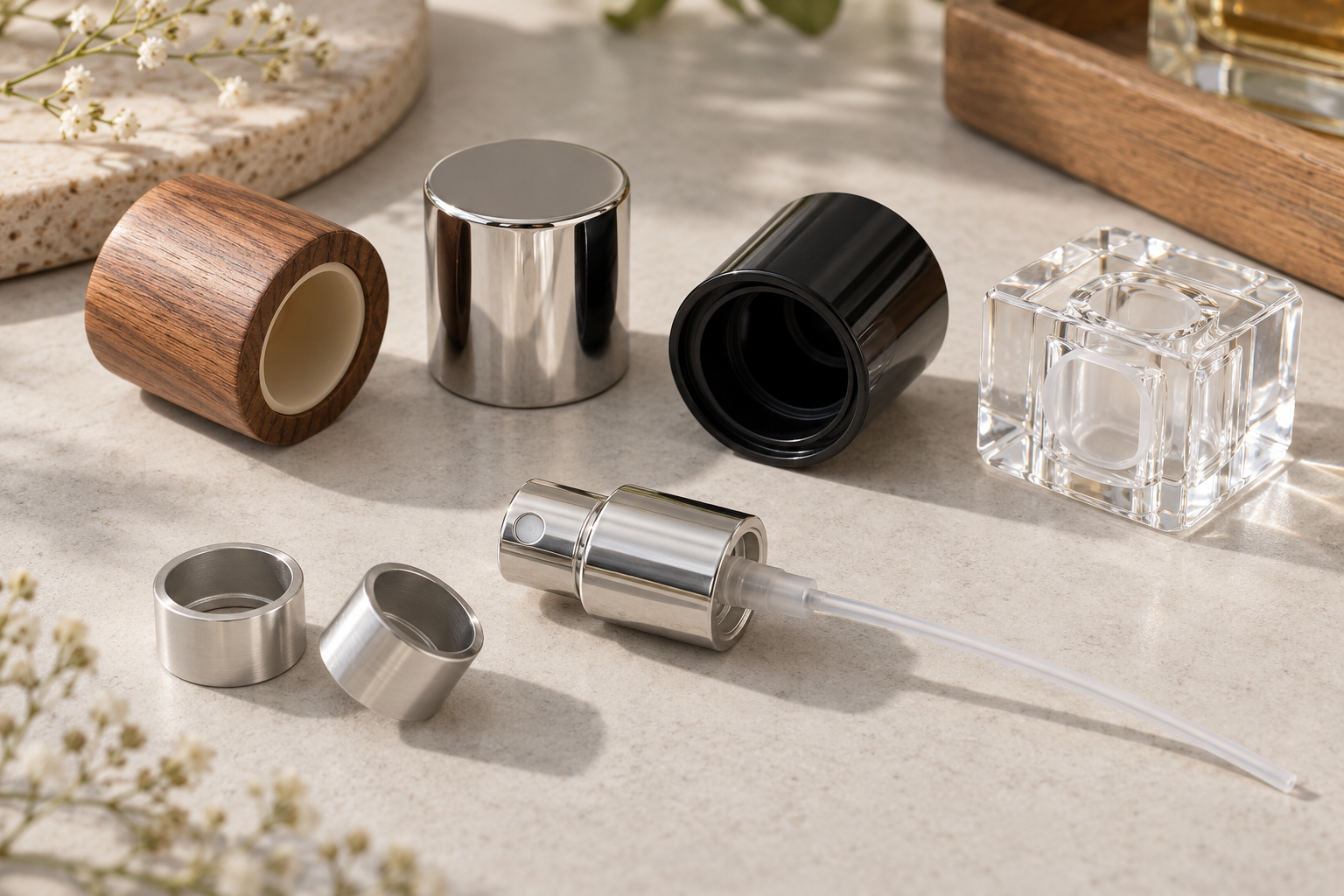
04 · Materials, fit and coordinated components.
Caps & Accessories
Zinc alloy die casting
Die-cast metal caps provide substantial shapes and weight. Selected plating or coating finishes can be added after casting.
Plastic injection moulding
ABS and suitable Surlyn grades offer different visual and tactile options. Painting, plating or UV finishing depends on the resin and cap construction.
CNC wood & acrylic machining
Turning, milling and polishing create wood or acrylic caps. A suitable internal liner can help achieve the required fit; assembly and material compatibility are checked for the bottle.
Aluminium component forming
Spinning or drawing processes form decorative collars and pump covers, depending on the part geometry and production route.
Pump crimping & assembly
Compatible FEA crimp-neck pumps are mechanically secured to the bottle neck. Neck size, ferrule, gasket, dip tube, spray output and sealing performance are checked as a complete assembly.
Process availability, tolerances and finish compatibility are confirmed for the exact model. Agree on the finish, dimensional requirements and component compatibility before confirming production.
Choose the right foundation
Glass Materials
Glass clarity and formulation are separate choices from the forming and decorating process.
Soda-Lime Glass
A common choice for production perfume bottles. Clarity, weight and shape depend on the glass specification and model.
High-Clarity Glass & Crystal
High-white glass is not automatically lead crystal. Crystal formulations may be lead-free or lead-containing; the required composition and optical properties must be specified.
Borosilicate Glass
A specialty material for selected applications. It is not the default choice for decorative perfume bottles; suitability is reviewed for the design and formula.
From idea to specification
Connect Your Finish
with the Complete Bottle.
Select the bottle, neck, pump, cap and packaging together. Share a visual reference, artwork, estimated quantity and destination so the details can be reviewed as one project.
B2B procurement & project enquiries
Request a Bulk Supply & Customization Quote
For fragrance brands, distributors, wholesalers and contract fillers. Send your model references, quantities per SKU, bottle and closure specifications, decoration, packaging and delivery requirements for a project quotation.
w32032319@gmail.comWhatsApp
+86 198 5218 1669
WeChat · 19852181669
Add us using this WeChat ID to discuss your bottle and packaging project.
For bulk procurement, include quantities per model, packing requirements, destination and preferred sea or air freight. We support international freight arrangements for export orders. MOQ, lead time and customization options are confirmed for the exact specification.